
Mexico nearshoring energy regulatory risk JPA INTSUM
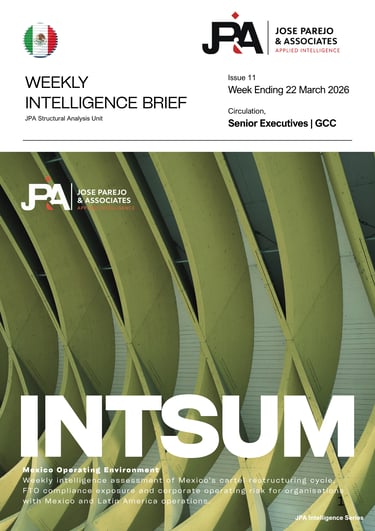
JPA INTSUM analyses Mexico nearshoring investment risk, Pemex energy nationalism and cartel corridor exposure for boards and corporations with supply chain exposure.
MEXICO & LATAM
JPA Structural Analysis Unit
4/30/20262 min read
CONTEXT — Mexico Operating Environment
MRCI Level: HIGH — Enforcement Cycle Active
Mexico's nearshoring opportunity — driven by US-China decoupling dynamics and USMCA framework incentives — is structurally real but operationally constrained. The Sheinbaum administration has maintained the energy nationalism framework inherited from the AMLO period, with Pemex institutional protection and CFE preference clauses creating regulatory friction for private and foreign energy operators. Simultaneously, organised crime territorial control over logistics corridors in Guanajuato, Jalisco, Sonora and Tamaulipas introduces direct operational risk for corporations establishing manufacturing and distribution infrastructure in Mexico's industrial heartland.
RISK
For corporations pursuing nearshoring strategies in Mexico, the structural risk is not macroeconomic but institutional and territorial. Energy supply reliability — particularly for industrial electricity consumers — is compromised by CFE's generation capacity deficit and the regulatory constraints on private renewable energy development. Cartel extortion, cargo theft and corridor taxation affect supply chain integrity across the Bajío industrial corridor and northern border states. Legal and compliance exposure on anti-corruption frameworks has intensified following USMCA dispute mechanisms activation on energy and labour provisions. Counterparty risk on Mexican state entities — including Pemex and CFE — requires active monitoring as fiscal positions deteriorate.
IMPLICATION FOR ORGANISATIONS
Boards and executive committees pursuing Mexico nearshoring strategies should assess their operational footprint against territorial risk maps rather than standard country risk ratings. The Bajío, northern border and Pacific corridor present divergent security and regulatory profiles that require disaggregated analysis. Energy supply risk — both cost and reliability — must be built into industrial investment models for the 2026–2028 horizon. JPA's Latin America desk provides weekly structural assessment of Mexico's regulatory environment, cartel corridor dynamics and nearshoring operational risk.
The full INTSUM covers: Mexico's nearshoring risk matrix across five industrial corridors; energy regulatory exposure and three scenarios for private sector operators; the 90-day action framework for boards entering or expanding Mexico exposure.
Full assessment available under institutional licence.
→ Request INTSUM Issue 01 — info@joseparejo-asociadosai.como
Published by Jose Parejo & Associates, JPA Structural Analysis Unit | 20 March 2026
Classification: Executive Summary — Unrestricted Distribution
For deep-dive analysis and monthly strategic outlook on this region, see JPA Pulse — Applied Strategic Intelligence.
For tailored operational assessments or advisory support, contact us at info@joseparejo-asociadosai.com
Privacy Policy. — Published Analysis. — Política de Responsabilidad Corporativa
Strategic Services & Risk Intelligence (EN) — Independent Citations. — Encyclopedia Reference
Insights / Frameworks / Strategic Intelligence: Global Strategic Intelligence 50 – Board-Level Framework (2026)
© 2025 JPA — Jose Parejo & Associates. All rights reserved. Presencia en plataformas: Enterprise League