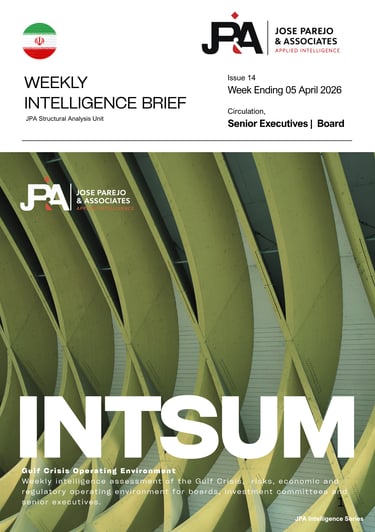
JPA Gulf Crisis Intelligence — INTSUM Issue 05 | Selective Blockade Entrenched | April 2026
Week 6: Iran entrenches permission-based Hormuz transit regime. Pentagon confirms F-15E and A-10 downed. Trump 48-hour ultimatum rejected. US intelligence rules out near-term reopening. War risk premiums 16x baseline. JPA structural analysis for boards and investment committees.
GULF & IRAN
JPA Structural Analysis Unit
4/5/20262 min read
CONTEXT — Gulf Operating Environment | Week Ending 5 April 2026
GOCI Level: CRITICAL — Selective Blockade Regime Active. Week 6.
The Strait of Hormuz has entered its sixth week of effective closure to commercial shipping. Iran has moved from threatened total closure to an entrenched, permission-based transit regime operational since 15 March — a selective blockade that allows controlled flows via an IRGC-managed corridor through Larak Island, maintaining market leverage while preserving calibrated diplomatic utility. Daily AIS-transmitting transits reached 16 on 1 April — up from near-zero in week one — but remain under 2% of the normal 60-vessel daily throughput. An estimated 150+ vessels remain stranded in Gulf waters, including approximately 40 Long Range tanker.
RISK
US intelligence this week formally assessed that Iran is unlikely to reopen Hormuz in the near term, treating the strait as its primary strategic instrument and not a transitory posture. The Pentagon confirmed the loss of two manned US aircraft — an F-15E Strike Eagle and an A-10 Thunderbolt II — to Iranian fire on 3–4 April, the first confirmed shootdowns of Operation Epic Fury. One F-15E crew member remains unaccounted for. 13 US service members have been killed since 28 February. President Trump issued a 48-hour ultimatum on 4 April demanding Hormuz be reopened. Iran rejected a parallel ceasefire proposal transmitted through a third-country intermediary. War risk insurance premiums remain at approximately 1% of hull value — 16x pre-conflict baseline — following partial stabilisation from 2.5% peak. UAE airports remain operational: DXB and AUH at approximately 60% combined capacity. Emirates operating ~70% pre-conflict schedule; Etihad operating limited schedule to ~80 destinations. Singapore Airlines has extended Dubai suspension through 31 May 2026.
IMPLICATION FOR ORGANISATIONS
US intelligence assessment removes Hormuz normalisation from any credible Q2 2026 planning baseline. The selective blockade architecture — combined with Iran's maximalist negotiating position and the 48-hour ultimatum rejection — signals a resolution horizon measured in months, not weeks. What this means operationally for your organisation — across supply chain, contracts, energy cost exposure and GCC counterparty risk — is the subject of this week's full assessment.
The full INTSUM Issue 05 covers: Iran's resolution doctrine and the three scenarios our structural analysis assigns probability to; the corporate decision matrix for organisations with Gulf exposure; and the 90-day action framework boards are using now.
Full assessment available under institutional licence.
→ Request INTSUM Issue 14 — info@joseparejo-asociadosai.como
Published by Jose Parejo & Associates, JPA Structural Analysis Unit | 20 March 2026
Classification: Executive Summary — Unrestricted Distribution
For deep-dive analysis and monthly strategic outlook on this region, see JPA Pulse — Applied Strategic Intelligence.
For tailored operational assessments or advisory support, contact us at info@joseparejo-asociadosai.com
Privacy Policy. — Published Analysis. — Política de Responsabilidad Corporativa
Strategic Services & Risk Intelligence (EN) — Independent Citations. — Encyclopedia Reference
Insights / Frameworks / Strategic Intelligence: Global Strategic Intelligence 50 – Board-Level Framework (2026)
© 2025 JPA — Jose Parejo & Associates. All rights reserved. Presencia en plataformas: Enterprise League